

































































































































































10 Simple Habits for Better Sleep Every Night
Author: RVLNSV PRASAD
Updated On: September 2026
About Us
Author Bio
Editorial Policy
Contact Us
Quick Answer
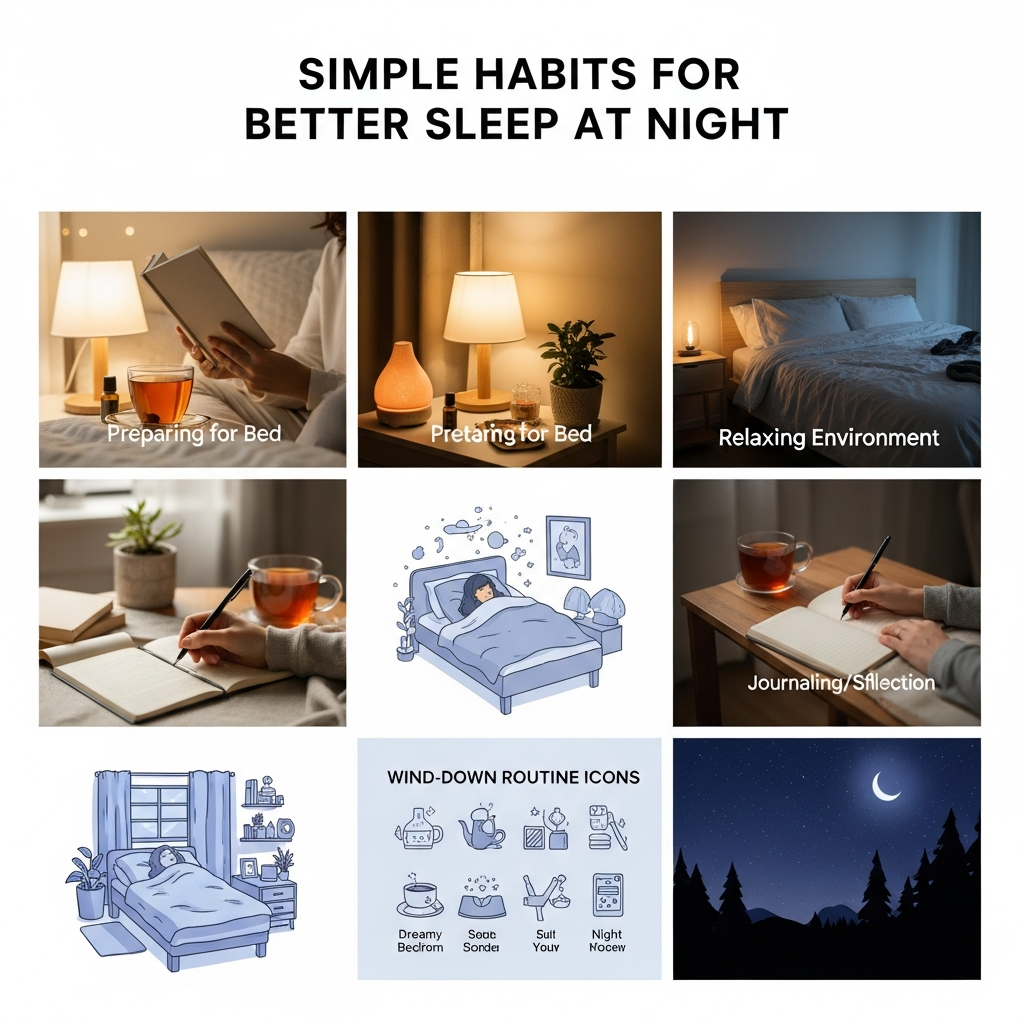
The most useful simple habits for better sleep are usually not complicated. A consistent sleep schedule, a comfortable bedroom, less evening screen exposure, sensible caffeine timing, daytime physical activity, daylight exposure, a relaxing pre-bed routine, and realistic expectations can all support healthier sleep.
The Centers for Disease Control and Prevention recommends that most adults aged 18–60 get at least 7 hours of sleep per night. Adults aged 61–64 generally need 7–9 hours, while adults 65 and older generally need 7–8 hours.
Sleep quality matters as well as sleep duration. Good sleep should generally be sufficiently long, reasonably uninterrupted, refreshing, and consistent.
If you regularly struggle to fall asleep, wake repeatedly, or feel excessively sleepy during the day, lifestyle changes may not be enough. Long-term insomnia is a medical condition, and the National Heart, Lung, and Blood Institute identifies cognitive behavioral therapy for insomnia (CBT-I) as a standard treatment approach for persistent insomnia.
Introduction
Finding simple habits for better sleep sounds easy until nighttime actually arrives.
You may plan to go to bed early, but then check one message. One message becomes several minutes of scrolling. You notice the time, put the phone away, and suddenly start thinking about tomorrow’s responsibilities.
That cycle can make bedtime feel like another task rather than a period of rest.
I experienced something similar several years ago.
I would lie in bed looking at the ceiling while repeatedly checking my phone. Even when I had enough time available for sleep, my mind did not seem ready to settle.
Eventually, I stopped looking for complicated solutions.
I started with smaller changes.
I reduced screen use before bed, kept my wake-up time more consistent, spent more time outdoors during the day, and created a short wind-down routine involving reading.
The changes were not dramatic overnight.
They became useful because I could actually maintain them.
That distinction is important.
A sleep routine does not have to be perfect to be helpful. The goal is to create conditions that make sleep easier while recognizing that occasional poor nights are normal.
Research also supports the importance of several of these basic behaviors. The NHLBI’s healthy sleep guidance recommends maintaining a regular sleep schedule, using the hour before bed for quiet activities, avoiding bright artificial light late in the evening, and getting regular physical activity.
The following habits combine those established recommendations with practical strategies that are easy to fit into ordinary life.
Why Good Sleep Habits Matter
Sleep affects much more than whether you feel tired the next morning.
Adequate sleep supports attention, memory, emotional well-being, metabolism, cardiovascular health, and everyday functioning.
The CDC notes that sufficient sleep can support healthy weight, mood, heart health, metabolism, attention, and memory, while insufficient sleep is associated with several chronic health risks.
The American Academy of Sleep Medicine and the Sleep Research Society recommend that healthy adults regularly obtain at least 7 hours of sleep per night. Their consensus statement was developed after reviewing thousands of scientific articles and considering evidence across multiple health outcomes.
However, sleep is not simply about reaching a number.
Someone who spends eight hours in bed but wakes repeatedly may not feel as refreshed as someone who obtains more continuous sleep.
That is why a better goal is healthy sleep, rather than simply spending more time in bed.
1. Keep the Same Wake-Up Time Every Day
One of the most useful simple habits for better sleep is also one of the least exciting.
Keep your wake-up time reasonably consistent.
Going to bed and waking up at dramatically different times from one day to another can make your sleep-wake rhythm less predictable.
The NHLBI recommends going to sleep and waking up around the same time each day, including weekends where possible.
You do not necessarily need to wake at exactly the same minute every morning.
A practical approach is to keep the difference relatively small.
Try this
Choose a realistic wake-up time.
For example:
Monday–Friday: 6:30 AM
Saturday–Sunday: around 7:00 AM
This is usually easier to maintain than completely changing your schedule every weekend.
Why this can help
A consistent wake time gives your daily routine a predictable anchor.
Once your wake time becomes more stable, bedtime may gradually become easier to regulate as well.
If you currently sleep at very different times each night, change gradually rather than forcing a dramatic overnight schedule.
2. Create a 30-Minute Screen-Free Wind-Down
Phones are useful, but bedtime scrolling can easily become longer than intended.
Recent research has strengthened the connection between electronic media use and sleep problems.
A 2024 systematic review and meta-analysis involving more than 41,000 participants found that electronic media use was associated with poorer sleep quality and increased sleep problems.
The National Sleep Foundation’s 2024 expert consensus statement also reviewed hundreds of empirical studies concerning screen use and sleep across the lifespan.
More recent evidence continues to examine this relationship. A 2025 systematic review and meta-analysis of 21 cohort studies involving more than 548,000 participants found associations between greater screen time and shorter sleep duration, delayed bedtimes, insomnia symptoms, and difficulty initiating sleep. The authors also noted that causality requires further investigation.
That last point matters.
The evidence does not mean that every person who uses a phone before bed will develop insomnia.
It means reducing unnecessary nighttime screen exposure is a reasonable sleep-supporting experiment.
My practical approach
Instead of trying to stop using your phone three hours before bed, start with 30 minutes.
During that time:
-
Put the phone on silent.
-
Keep it away from the pillow.
-
Read a physical book.
-
Listen to quiet music.
-
Prepare clothes for tomorrow.
-
Do gentle stretching.
-
Talk with family.
-
Sit quietly for a few minutes.
The goal is not perfection.
It is creating a transition between daytime activity and sleep.
3. Make Your Bedroom Sleep-Friendly
Your bedroom does not need to look like a luxury hotel.
It needs to support rest.
A cool, quiet, dark environment is one of the basic recommendations from the NHLBI.
Look at these five factors.
| Factor | Simple adjustment |
|---|---|
| Light | Use dim lighting before bed. |
| Noise | Reduce unnecessary sound. |
| Temperature | Keep the room comfortably cool. |
| Bedding | Use comfortable pillows and bedding. |
| Clutter | Keep the sleeping area reasonably calm. |
You do not need to purchase expensive sleep equipment.
Sometimes the simplest improvement is removing one thing that repeatedly bothers you.
For example, if street light enters through your window, blackout curtains may help.
If noise is the problem, earplugs or steady background noise may be worth trying.
The important point is to identify your actual barrier rather than buying products simply because they are marketed as sleep solutions.
4. Cut Off Caffeine Earlier
Caffeine can remain active in the body for hours.
That afternoon coffee that seems harmless may still affect nighttime sleep.
A systematic review and meta-analysis published in Sleep Medicine Reviews examined 24 studies and found that caffeine reduced total sleep time and sleep efficiency while increasing the time needed to fall asleep.
The effect varied between individuals and depended partly on the amount and timing of caffeine.
That means there is no single universal cutoff that works perfectly for everyone.
If you have trouble sleeping
Experiment with stopping caffeine earlier.
For example:
Morning: coffee or tea
Early afternoon: optional smaller serving
Late afternoon/evening: switch to caffeine-free drinks.
Remember that caffeine can come from more than coffee.
It may also be present in:
-
Tea
-
Energy drinks
-
Cola
-
Chocolate
-
Pre-workout products
-
Certain medications
If you regularly consume substantial caffeine, reducing it gradually may be more comfortable than stopping suddenly.
5. Get Daylight and Outdoor Time
Your body clock responds strongly to light.
Light exposure helps the brain distinguish daytime from nighttime and contributes to the timing of the sleep-wake cycle.
A systematic review of studies in community-dwelling adults found that the timing and intensity of light exposure were associated with changes in sleep timing, with morning light generally associated with earlier sleep timing and some improvements in self-reported sleep.
This does not mean you need to stare directly at the sun.
Never do that.
Instead, spend some time outdoors during daylight.
An easy routine
After waking:
-
Open the curtains.
-
Step outdoors if practical.
-
Walk for 10–20 minutes.
-
Get normal daylight exposure while continuing your morning activities.
This habit combines daylight with movement, which can make it especially practical.
It is also inexpensive.
6. Move Your Body During the Day
Exercise is not only about weight management or cardiovascular fitness.
It can also support sleep quality.
A 2024 systematic review and network meta-analysis examined different exercise interventions and their effects on sleep quality in adults.
Another 2024 meta-analysis examined exercise and sleep quality in the general population and found evidence supporting exercise as a useful non-pharmacological strategy for improving sleep quality.
You do not need an intense workout every evening.
Try:
A realistic target
If you currently do almost no activity, start with a 10-minute walk.
Then build gradually.
A habit that survives for months is generally more useful than an exhausting routine that lasts four days.
The NHLBI also recommends regular daytime physical activity while noting that exercising too close to bedtime may make it harder for some people to fall asleep.
7. Build a Simple Bedtime Routine
The brain benefits from repeated signals.
If every night follows the same sequence, those activities can become associated with winding down.
A bedtime routine might look like:
9:30 PM: lower household lighting
9:40 PM: prepare for tomorrow
9:50 PM: wash face and brush teeth
10:00 PM: read
10:15 PM: relaxation breathing
10:30 PM: lights out
Your schedule does not have to match this example.
The sequence matters more than the exact clock time.
Keep the routine short.
You do not need 15 different wellness practices.
Choose two or three activities that genuinely make you feel calmer.
For example:
-
Reading
-
Gentle stretching
-
Quiet music
This is easier to maintain than an elaborate routine requiring an hour of preparation.
8. Avoid Heavy Meals Close to Bed
A very large meal immediately before lying down can be uncomfortable for some people.
You may notice fullness, reflux, bloating, or general discomfort.
The CDC’s sleep guidance recommends avoiding large meals before bedtime as part of healthy sleep habits.
This does not mean you must go to bed hungry.
If you genuinely need food later in the evening, choose an appropriate portion that you tolerate well.
Practical evening choices
Depending on your dietary needs, a small snack might include:
-
Yogurt and fruit
-
A small serving of oats
-
Fruit and a few nuts
-
A light protein-rich snack
The goal is comfort rather than strict food rules.
If you regularly experience nighttime reflux, discuss persistent symptoms with a healthcare professional.
9. Use a “Worry Parking” Routine
Sometimes the body is tired but the mind is still working.
You remember an unfinished task.
Then you remember another.
Soon you are planning tomorrow instead of sleeping.
One practical strategy is to write down the thoughts before getting into bed.
Try a three-line note.
Tomorrow: one important task
Worry: one thing currently bothering me
Next step: one action I can take tomorrow
Then stop.
You are not trying to solve your entire life at 10:30 PM.
You are simply giving your brain a place to store the thought.
Research into expressive writing and insomnia has produced mixed results. For example, a randomized trial found that a particular writing intervention reduced one measure of pre-sleep cognitive arousal but did not significantly reduce sleep-onset latency.
So journaling should be presented as a practical relaxation strategy rather than a proven insomnia treatment.
If worry is persistent and severe, CBT-I or professional support may be more appropriate.
10. Stop Forcing Yourself to Sleep
This is one of the most overlooked simple habits for better sleep.
You cannot always force sleep by trying harder.
Sometimes repeatedly checking the clock creates more frustration.
You notice that it is 11:45 PM.
Then 12:10 AM.
Then 12:40 AM.
The thought becomes:
“I must sleep now.”
That pressure can make relaxation harder.
For persistent insomnia, stimulus-control strategies are part of CBT-I. The NHLBI explains that stimulus control helps people associate the bed with sleep and recommends getting out of bed when unable to sleep rather than remaining awake in bed.
For occasional sleeplessness, you can keep things simple.
If you are wide awake, get up for a quiet activity in low light and return to bed when you feel sleepy.
Avoid turning that period into another opportunity for scrolling.
A Simple Sleep Routine You Can Actually Maintain
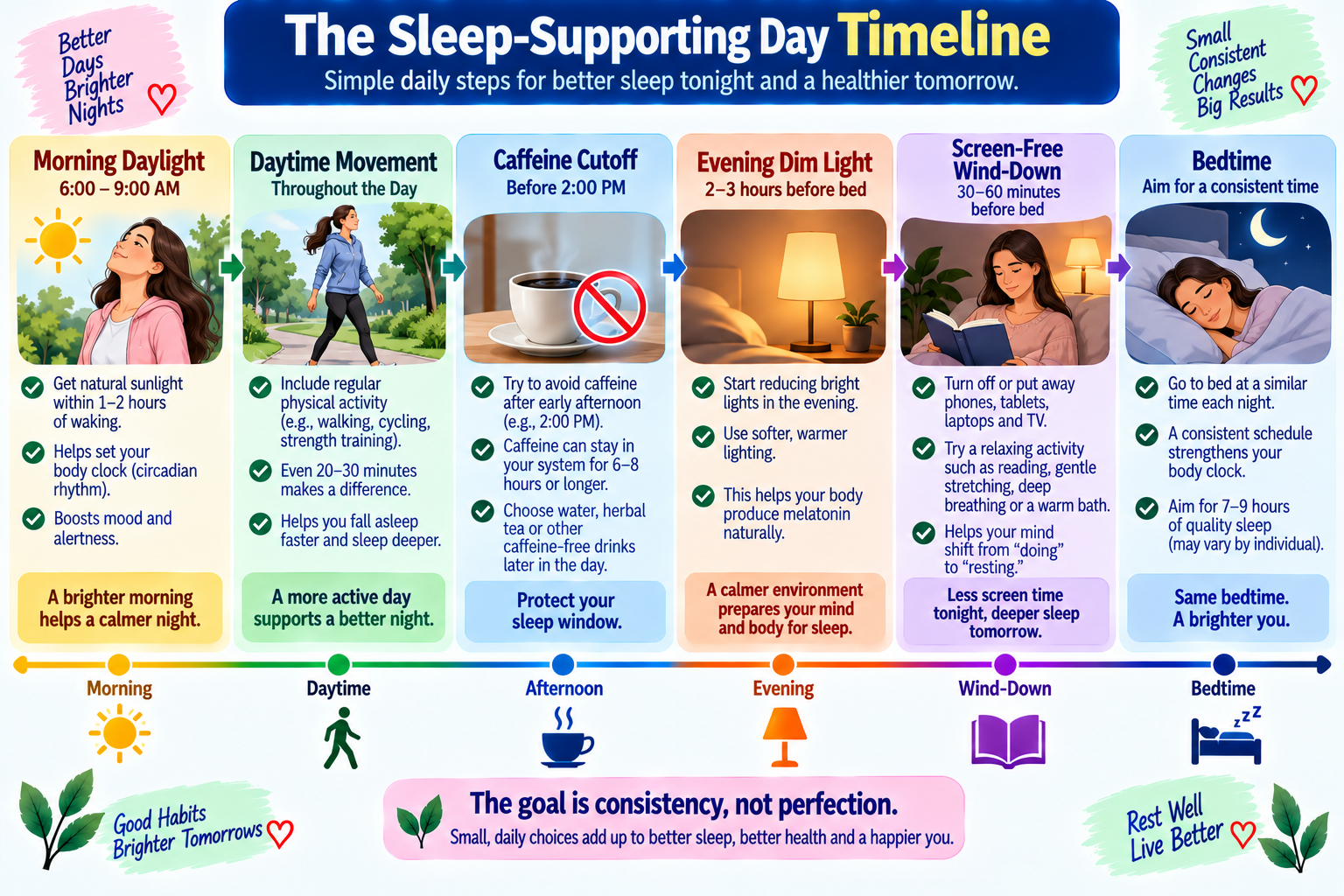
Here is an example of how the habits can work together.
| Time | Habit |
|---|---|
| 6:30 AM | Wake at a consistent time. |
| 6:40 AM | Open curtains and get daylight. |
| Morning | Normal breakfast and daily activity |
| Afternoon | Finish most caffeine earlier. |
| Evening | Exercise or take a walk when practical. |
| 9:30 PM | Lower lights |
| 9:45 PM | Reduce screen use. |
| 10:00 PM | Read or relax. |
| 10:15 PM | Write tomorrow’s key task. |
| 10:30 PM | Go to bed. |
This is only an example.
Your schedule may be completely different because of work, family responsibilities, shift work, or other circumstances.
The important principles are consistency, sufficient sleep opportunity, a sleep-friendly environment, and a gradual reduction in stimulating activities.
What Recent Research Adds to These Sleep Habits
The basic sleep advice has not suddenly changed.
What has changed is the amount of research examining how modern behaviors interact with sleep.
Screen exposure
Recent reviews continue to find associations between electronic media use and poorer sleep outcomes. The 2024 National Sleep Foundation consensus statement examined a large body of evidence and considered both pre-bedtime content and screen-related light.
A 2025 meta-analysis involving more than half a million participants also found associations between greater screen exposure and shorter sleep, delayed bedtimes, insomnia symptoms, and difficulty initiating sleep.
This strengthens the practical case for creating a screen-free period before bed, while recognizing that association does not automatically prove causation.
Exercise
Research published in 2024 continues to support physical activity as a useful non-drug strategy for sleep quality. Systematic reviews have examined not only whether exercise helps but also which types of exercise may be most useful.
The practical takeaway is reassuring.
You do not necessarily need a specialized sleep workout.
Regular movement is a reasonable starting point.
Sleep duration
The core recommendation remains that adults should generally obtain at least seven hours of sleep regularly.
The AASM consensus statement continues to list the adult sleep-duration recommendation among its consensus guidance.
The CDC similarly recommends at least seven hours for adults aged 18–60.
The important distinction is that sleep quantity and sleep quality are related but not identical.
A 7-Day Sleep Reset Without Extreme Rules
If your sleep routine is currently inconsistent, do not try to change everything at once.
Day 1: Fix your wake time.
Choose a realistic wake-up time.
Day 2: Move caffeine earlier
Avoid caffeine later in the day and observe whether your sleep changes.
Day 3: Add daylight
Spend some time outside during the morning or early part of the day.
Day 4: Reduce nighttime screen use
Start with 30 minutes before bed.
Day 5: Improve the bedroom
Reduce light, noise, clutter, or temperature problems.
Day 6: Add movement
Take a walk or perform an appropriate workout during the day.
Day 7: Repeat instead of adding another rule.
This is important.
Do not assume you need a tenth new habit.
Repeat the habits that felt realistic.
Consistency is the real experiment.
Common Mistakes That Can Make Sleep Habits Harder
Mistake 1: Changing everything at once
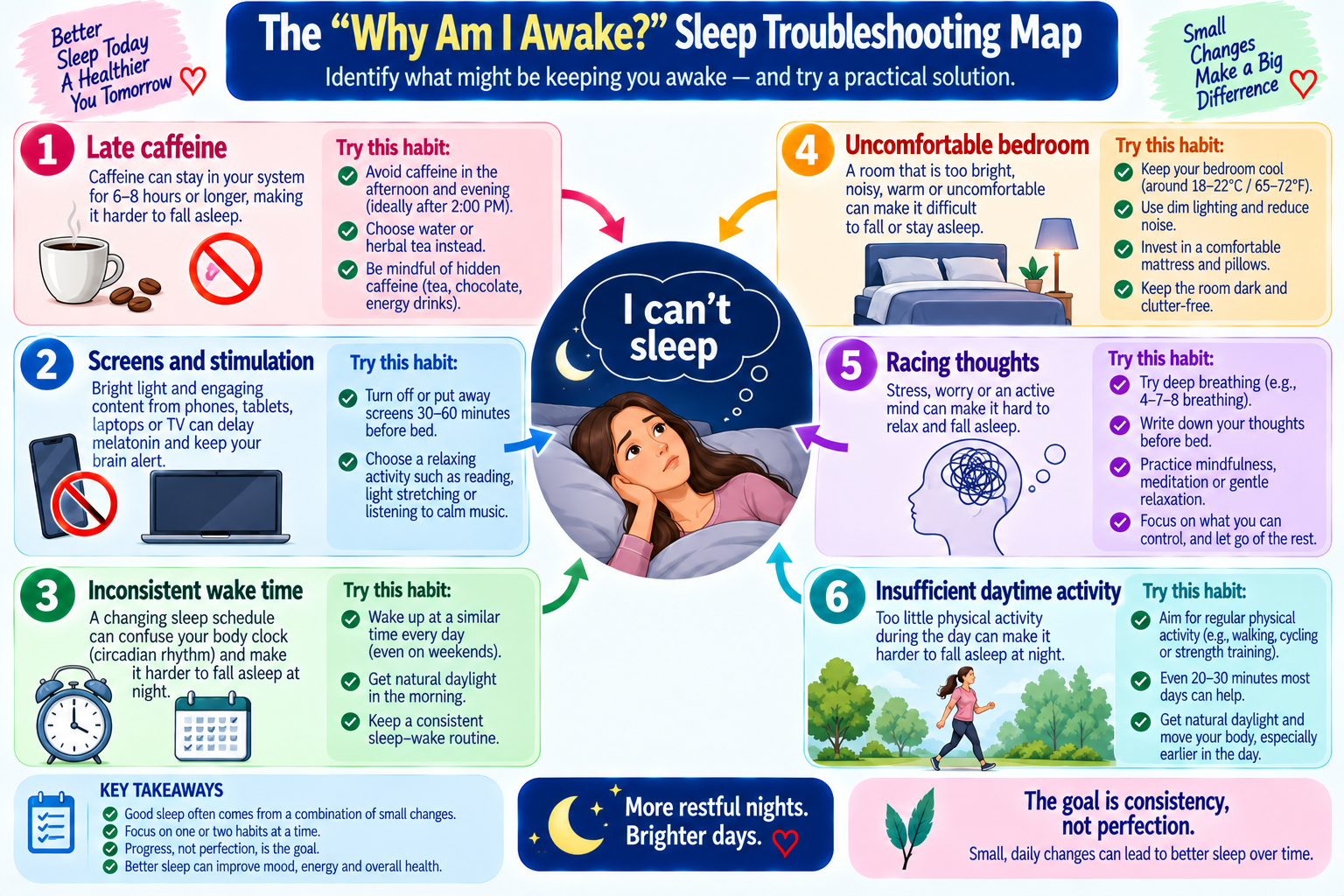
A routine with 15 new rules may look impressive.
It may also be impossible to maintain.
Choose one or two changes first.
Mistake 2: Sleeping in dramatically on weekends
A major weekend schedule shift can make Monday morning harder.
Try to keep your wake time reasonably consistent.
Mistake 3: Drinking caffeine too late
You may fall asleep eventually while still experiencing reduced sleep quality.
If you suspect caffeine is affecting you, experiment with an earlier cutoff.
Mistake 4: Using the phone in bed
The problem is not simply the screen.
The content itself can be stimulating.
Messages, work emails, news, social media arguments, and emotionally intense videos can all keep the brain engaged.
Mistake 5: Watching the clock
Constantly checking the time can increase frustration.
Consider turning the clock away from the bed.
Mistake 6: Treating every bad night as a failure
One poor night does not mean your sleep routine has failed.
Look at the pattern across weeks rather than judging yourself after one night.
Mistake 7: Using alcohol as a sleep solution
Alcohol may make some people feel sleepy initially, but it can produce lighter or more disrupted sleep later.
The NHLBI specifically advises avoiding alcohol close to bedtime as part of healthy sleep guidance.
What If These Simple Habits Do Not Work?
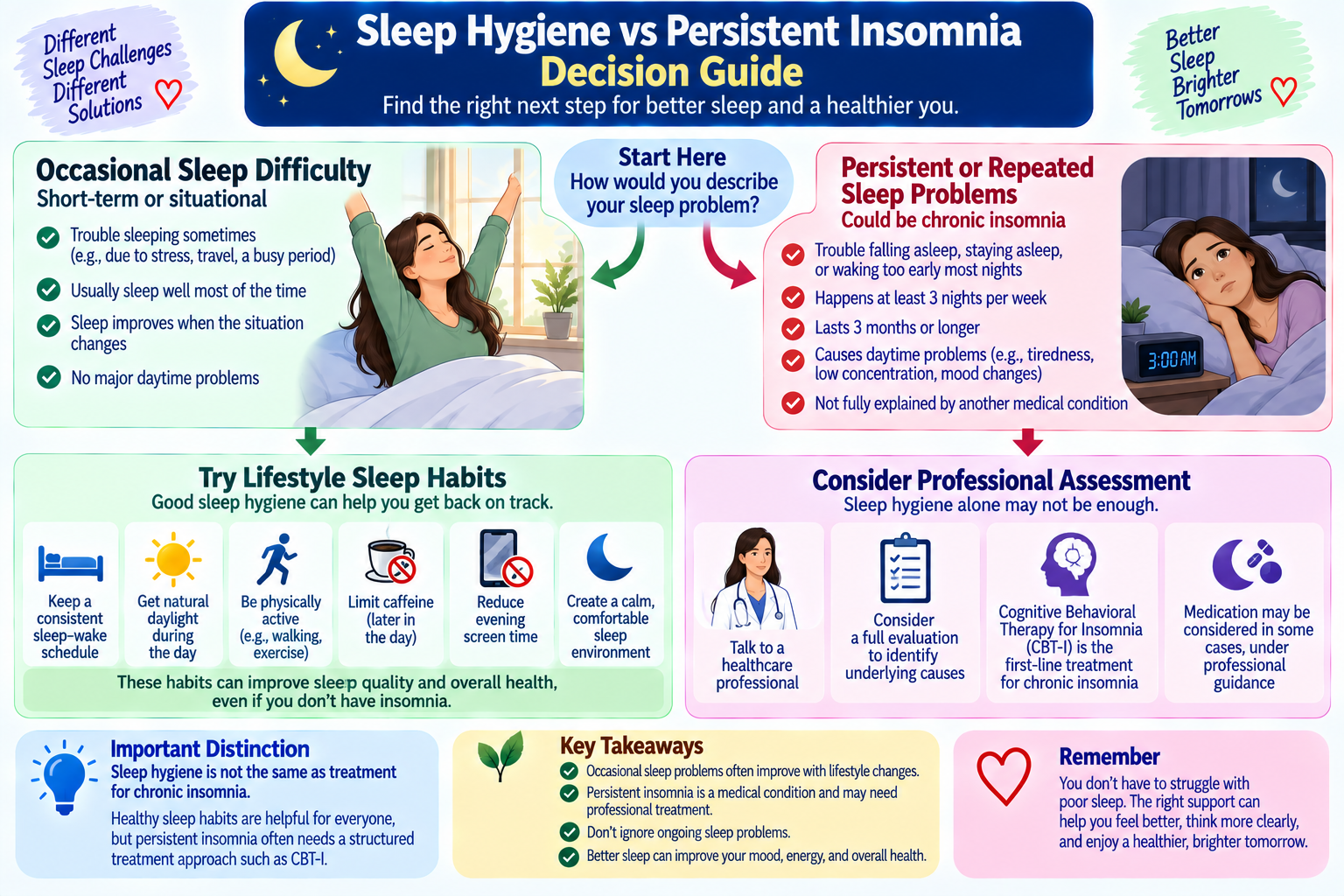
Sometimes the problem is not poor sleep hygiene.
You may be dealing with insomnia, sleep apnea, restless legs syndrome, medication effects, depression, anxiety, chronic pain, reflux, or another medical issue.
Persistent insomnia has a specific clinical definition.
The NHLBI describes chronic insomnia as difficulty sleeping at least three nights per week for more than three months when the problem is not fully explained by another health condition.
Seek professional advice if:
-
Sleep problems continue for months.
-
You are excessively sleepy during the day.
-
You regularly wake gasping or choking.
-
You snore loudly and have breathing pauses.
-
You wake with headaches frequently.
-
You cannot function normally because of poor sleep.
-
You have persistent anxiety or depression symptoms.
-
You rely on alcohol or medication to fall asleep.
Do not assume that more sleep tips are always the answer.
A sleep disorder may require diagnosis and treatment.
CBT-I: An Important Treatment for Persistent Insomnia
Sleep hygiene is useful.
It is not the same thing as treating chronic insomnia.
CBT-I combines several behavioral and psychological techniques designed specifically for insomnia.
The NHLBI describes CBT-I as a treatment typically delivered over several weeks and notes that it is usually recommended as the first treatment option for long-term insomnia.
CBT-I can include:
-
Cognitive therapy
-
Relaxation strategies
-
Sleep education
-
Stimulus control
-
Sleep restriction therapy
This is an important distinction for readers because a blog article should not imply that turning off your phone will cure chronic insomnia.
Healthy habits support sleep.
Persistent insomnia deserves proper assessment.
People-First Sleep Tips That Are Easy to Try
Some sleep advice fails because it assumes people have unlimited time.
Real life is different.
- You may work late.
- You may care for children.
- You may commute.
- You may work shifts.
- You may have noisy neighbors.
- You may share a bedroom.
- You may live in a hot climate.
- You may not be able to follow an ideal sleep schedule.
So instead of asking:
“What is the perfect sleep routine?”
Ask:
“What is the smallest change that improves my sleep without making my life harder?”
For one person, that might mean putting the phone outside the bedroom.
For another, it may mean stopping caffeine after lunch.
Someone else may benefit more from a short evening walk.
Another person may need professional assessment rather than another bedtime trick.
This approach makes sleep advice more realistic.
My Personal Experience
My biggest lesson was that I did not need a complicated nighttime routine.
I needed a routine that I could realistically repeat, so I reduced my late-night phone use, replaced some of that time with reading, and tried to maintain a more consistent wake-up time.
Getting outside during the day became another simple habit.
None of these changes produced a miracle overnight.
The improvement came from repeating them.
That experience also taught me to be careful about presenting personal experience as scientific evidence.
What helps one person may not help another.
That is why the recommendations in this article are supported by public-health guidance and research rather than by my experience alone.
Quick Sleep Checklist
Before bed, ask yourself:
-
Did I avoid excessive caffeine late in the day?
-
Is my bedroom comfortable?
-
Have I reduced unnecessary screen use?
-
Did I give myself enough time to sleep?
-
Did I follow a reasonably consistent schedule?
-
Is my mind racing about tomorrow?
-
Would writing down tomorrow’s tasks help?
-
Am I trying to force sleep?
-
Have I been physically active during the day?
-
Is this an occasional bad night or a persistent problem?
You do not need a perfect score.
Use the checklist to identify one practical change.
Key Takeaways
-
Simple habits for better sleep work best when they are realistic enough to repeat.
-
Most adults need at least 7 hours of sleep regularly.
-
Keep your wake-up time reasonably consistent.
-
Create a screen-free wind-down period before bed.
-
Keep your bedroom dark, quiet, and comfortably cool.
-
Move your body regularly during the day.
-
Get normal daylight exposure during daytime hours.
-
Experiment with reducing caffeine earlier in the day.
-
Avoid very large meals close to bedtime.
-
Use a simple routine to reduce mental stimulation before sleep.
-
Do not treat one poor night as a failure.
-
Persistent insomnia should not be managed with sleep hygiene alone; CBT-I is an established treatment approach.
Frequently Asked Questions
What are the simplest habits for better sleep?
Start with a consistent wake-up time, less evening screen use, earlier caffeine, regular daytime movement, daylight exposure, and a calm bedroom.
You do not need to adopt all of these simultaneously.
How many hours should adults sleep?
Most adults aged 18–60 should regularly get at least 7 hours of sleep. The CDC recommends 7–9 hours for adults aged 61–64 and 7–8 hours for adults 65 and older.
Individual sleep needs can vary.
Does using a phone before bed affect sleep?
Research has found an association between electronic media use and poorer sleep outcomes. Recent reviews support reducing unnecessary screen exposure around bedtime, although the strength and mechanisms of the relationship can vary.
How long before bed should I stop using my phone?
There is no universally proven number of minutes that works for everyone.
A practical starting point is 30 minutes without unnecessary screen use.
If that feels helpful, you can extend the period.
Does exercise improve sleep?
Evidence supports regular physical activity as a useful strategy for improving sleep quality in adults. Recent systematic reviews have examined several forms of exercise and found beneficial effects on sleep outcomes.
Does caffeine affect sleep?
Yes.
A systematic review and meta-analysis found that caffeine can reduce total sleep time and sleep efficiency while increasing sleep-onset time.
Individual sensitivity varies, so earlier caffeine cutoff times may be useful for people who are particularly sensitive.
Does journaling help you sleep?
Journaling may help some people organize worries and reduce mental clutter, but evidence for directly improving insomnia is limited and mixed.
It should be viewed as a relaxation technique rather than a proven insomnia treatment.
What should I do if I cannot fall asleep?
Avoid repeatedly checking the clock.
If you remain awake and frustrated, a quiet activity in low light may be preferable to staying in bed while becoming increasingly anxious about sleep.
For persistent insomnia, discuss CBT-I with a healthcare professional.
Can these habits cure insomnia?
Not necessarily.
Healthy sleep habits can support better sleep, but chronic insomnia may require specific treatment.
The NHLBI identifies CBT-I as an important treatment for long-term insomnia.
When should I see a doctor about poor sleep?
Seek professional advice if sleep problems persist, interfere with daytime functioning, or occur alongside symptoms such as loud snoring, gasping during sleep, severe daytime sleepiness, or other concerning symptoms.
Conclusion
Simple habits for better sleep do not have to involve expensive products, complicated routines, or unrealistic bedtime rules.
Start with the fundamentals.
Give yourself enough time to sleep.
Keep your wake-up time reasonably consistent.
Reduce unnecessary screen exposure at night.
Watch your caffeine timing.
Get daylight during the day.
Move your body regularly.
Make your bedroom comfortable.
Create a short wind-down routine.
And when your mind becomes busy, avoid turning sleep into another performance test.
These habits are not guaranteed to solve every sleep problem.
That is an important part of honest health advice.
Persistent insomnia, sleep apnea, restless legs syndrome, medication effects, and other conditions require appropriate evaluation.
For ordinary sleep difficulties, however, small changes can create a more supportive environment for natural sleep.
My own experience taught me that the most useful routine was not the most complicated one.
It was the one I could continue.
Better sleep is rarely about achieving perfection.
It is about giving your body and mind the right conditions often enough that healthy sleep becomes easier.
Author Note
I am RVLNSV PRASAD, a wellness writer focused on practical health habits, nutrition, fitness, and evidence-informed lifestyle information.
My personal experience with sleep difficulties helped me understand how frustrating poor sleep can feel. However, personal experience is not clinical evidence.
For that reason, this article combines practical observations with evidence from organizations such as the CDC, NIH/NHLBI, American Academy of Sleep Medicine, National Sleep Foundation, and peer-reviewed research indexed in PubMed.
Medical Disclaimer
This article is for general educational purposes only. It does not replace professional medical advice, diagnosis, or treatment.
Do not use sleep tips to delay medical evaluation when symptoms are persistent, severe, or unusual.
If you have ongoing insomnia, suspected sleep apnea, severe daytime sleepiness, breathing problems during sleep, or another concerning symptom, speak with a qualified healthcare professional.
Fitness Disclaimer
Physical activity should match your current fitness level, abilities, age, and medical circumstances.
If you have been inactive, begin gradually rather than starting an intense exercise program immediately.
Stop exercising and seek appropriate medical advice if you experience concerning symptoms such as chest pain, fainting, severe shortness of breath, or unusual dizziness.
Regular movement can support sleep, but exercise should complement—not replace—appropriate medical care.
Sources
- Mayo Clinic – Sleep tips: 7 steps to better sleep
- Sleep Foundation – Healthy Sleep Tips
- CDC – About Sleep and Sleep Health
- NHLBI – Sleep Deprivation and Deficiency
- NHLBI – Your Sleep/Wake Cycle
- American Academy of Sleep Medicine – Healthy Sleep Habits
- Harvard Health – Understanding sleep
- Cleveland Clinic – Sleep Hygiene












[…] Simple Habits for Better Sleep at Night: A Comprehensive Guide […]
[…] Simple Habits for Better Sleep at Night: A Comprehensive Guide […]
[…] Simple Habits for Better Sleep at Night: A Comprehensive Guide […]
[…] Simple Habits for Better Sleep at Night: A Comprehensive Guide […]
[…] Simple Habits for Better Sleep at Night: A Comprehensive Guide […]
[…] Simple Habits for Better Sleep at Night: A Comprehensive Guide […]
[…] Simple Habits for Better Sleep at Night: A Comprehensive Guide […]
[…] Simple Habits for Better Sleep at Night: A Comprehensive Guide […]
[…] Simple Habits for Better Sleep at Night: A Comprehensive Guide […]
[…] Simple Habits for Better Sleep at Night: A Comprehensive Guide […]
[…] Simple Habits for Better Sleep at Night: A Comprehensive Guide […]
[…] Simple Habits for Better Sleep at Night: A Comprehensive Guide […]
[…] Simple Habits for Better Sleep at Night: A Comprehensive Guide […]
[…] Simple Habits for Better Sleep at Night: A Comprehensive Guide […]
[…] Simple Habits for Better Sleep at Night: A Comprehensive Guide […]
[…] Simple Habits for Better Sleep at Night: A Comprehensive Guide […]
[…] Simple Habits for Better Sleep at Night: A Comprehensive Guide […]
[…] Simple Habits for Better Sleep at Night: A Comprehensive Guide […]
[…] Simple Habits for Better Sleep at Night: A Comprehensive Guide […]
[…] Simple Habits for Better Sleep at Night: A Comprehensive Guide […]
[…] Simple Habits for Better Sleep at Night: A Comprehensive Guide […]
[…] Simple Habits for Better Sleep at Night: A Comprehensive Guide […]
[…] Simple Habits for Better Sleep at Night: A Comprehensive Guide […]
[…] Simple Habits for Better Sleep at Night: A Comprehensive Guide […]
[…] Simple Habits for Better Sleep at Night: A Comprehensive Guide […]
[…] Simple Habits for Better Sleep at Night: A Comprehensive Guide […]
[…] Simple Habits for Better Sleep at Night: A Comprehensive Guide […]
[…] Simple Habits for Better Sleep at Night: A Comprehensive Guide […]
[…] Simple Habits for Better Sleep at Night: A Comprehensive Guide […]
[…] Simple Habits for Better Sleep at Night: A Comprehensive Guide […]
[…] Simple Habits for Better Sleep at Night: A Comprehensive Guide […]
[…] Simple Habits for Better Sleep at Night: A Comprehensive Guide […]
[…] Simple Habits for Better Sleep at Night: A Comprehensive Guide […]
[…] Simple Habits for Better Sleep at Night: A Comprehensive Guide […]
[…] Simple Habits for Better Sleep at Night: A Comprehensive Guide […]
[…] Simple Habits for Better Sleep at Night: A Comprehensive Guide […]
[…] Simple Habits for Better Sleep at Night: A Comprehensive Guide […]
[…] Simple Habits for Better Sleep at Night: A Comprehensive Guide […]
[…] Simple Habits for Better Sleep at Night: A Comprehensive Guide […]
[…] Simple Habits for Better Sleep at Night: A Comprehensive Guide […]
[…] Simple Habits for Better Sleep at Night: A Comprehensive Guide […]
[…] Simple Habits for Better Sleep at Night: A Comprehensive Guide […]
[…] Simple Habits for Better Sleep at Night: A Comprehensive Guide […]
[…] Simple Habits for Better Sleep at Night: A Comprehensive Guide […]